Harper Krüger · 3 November 2026
Integrating Indigenous Knowledge with Modern Cotton Breeding for Arid Adaptation
Communities in dryland regions have selected cotton varieties over generations based on observed traits such as deep root systems and fiber retention during irregular rainfall periods, and contemporary breeding programs now incorporate these selections into genomic databases to accelerate development of resilient strains. Researchers document how traditional seed-saving practices in areas like the Sahel and parts of the American Southwest preserve genetic diversity that supports adaptation to temperature swings and soil moisture deficits.
Traditional Knowledge Systems in Arid Cotton Cultivation
Farmers in arid zones have long monitored plant responses to fluctuating conditions, noting which landraces maintain boll formation when rains arrive late or when heat spikes occur during flowering stages, and ethnobotanical records show that these observations guided seed exchanges along historical trade routes across North Africa and Central Asia. Studies from multiple regions indicate that such practices maintain heterozygosity in local populations, which provides a buffer against pests and variable weather patterns that modern monocultures sometimes lack.
Documented Practices and Their Genetic Foundations
Indigenous groups in northwest India and northern Mexico have employed spacing techniques and intercropping with drought-tolerant legumes to conserve soil moisture around cotton plants, and soil analyses confirm that these methods enhance microbial activity that supports root penetration in compacted arid soils. Genetic sampling of preserved seeds reveals alleles associated with stomatal regulation and osmotic adjustment that align with traits farmers historically prioritized through visual and tactile selection.
Contemporary Breeding Approaches for Cotton Resilience
Plant breeders apply marker-assisted selection and genomic prediction models to identify quantitative trait loci linked to water-use efficiency and heat tolerance in cotton germplasm collections, while field trials in controlled arid environments quantify yield stability under simulated rainfall variability. Data from multi-location experiments show that lines developed through these methods exhibit improved fiber quality retention when exposed to temperatures exceeding 38 degrees Celsius during critical growth phases.
Institutions in Australia and Canada conduct parallel research programs that cross-reference genomic sequences with phenotypic data collected from drought-stressed plots, and results indicate that stacking multiple tolerance traits requires careful balancing to avoid trade-offs in lint percentage. Breeding pipelines now integrate high-throughput phenotyping platforms that measure canopy temperature and chlorophyll fluorescence in real time, allowing faster identification of promising genotypes.

Linking Knowledge Systems Through Collaborative Frameworks
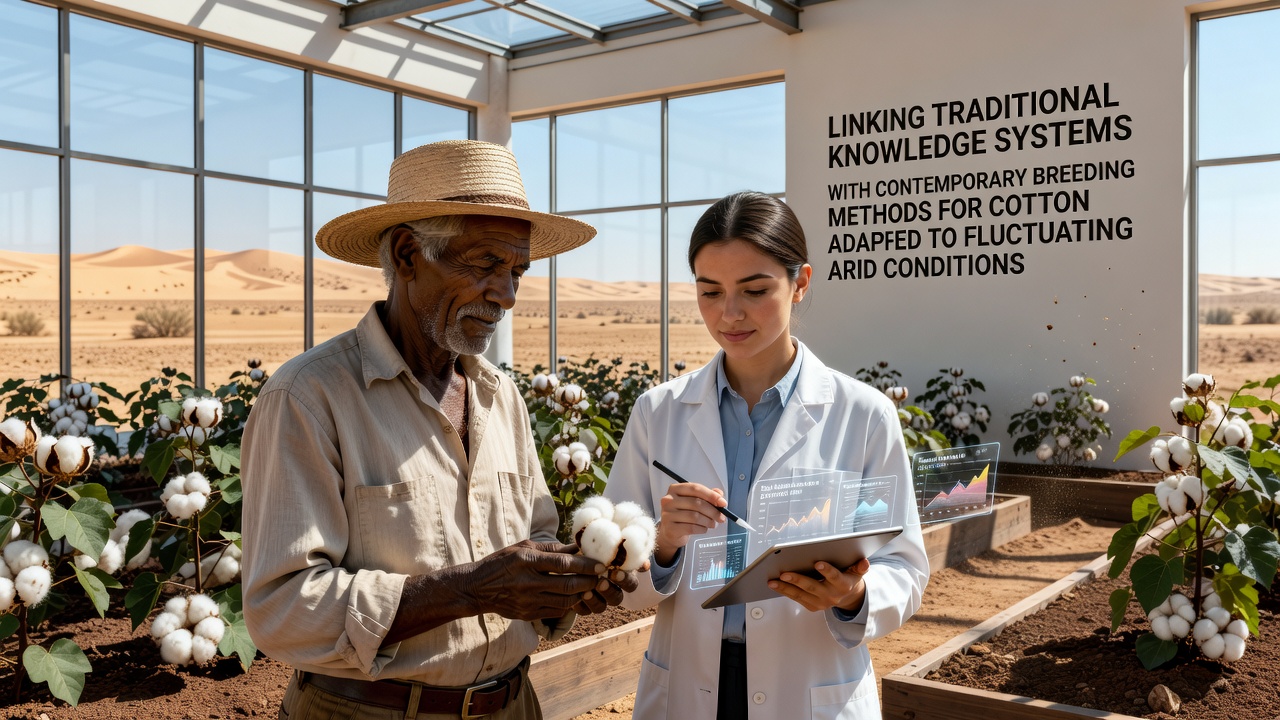
Projects in East Africa and the southwestern United States combine farmer participatory trials with molecular characterization, where local cultivators evaluate early-generation breeding lines under actual fluctuating conditions and breeders refine selections based on both performance metrics and traditional quality criteria such as fiber strength and seed viability after storage. According to reports from the Food and Agriculture Organization, these hybrid approaches have accelerated the release of varieties that retain productivity when precipitation varies by more than 40 percent year to year.
November 2026 will feature an international arid agriculture summit where participants plan to present updated protocols for registering farmer-developed landraces alongside elite breeding lines in national gene banks, and preliminary agendas indicate sessions focused on data-sharing platforms that merge oral histories with genomic metadata. Such events build on earlier exchanges that demonstrated how traditional timing of planting based on lunar cycles or wind patterns can inform model predictions of optimal sowing windows under climate variability.
Case Examples from Different Regions
One initiative in western Australia incorporated Aboriginal observations of soil cracking patterns as indicators of subsurface water availability into precision irrigation scheduling for cotton, and resulting trials reported more consistent emergence rates during erratic spring rains. In parallel, researchers at a Canadian agricultural research station analyzed heritage varieties from arid zones of the Mediterranean and identified molecular markers for late-season drought recovery that have since entered crossing blocks with commercial upland cotton.
Challenges in Data Integration and Scaling
Aligning qualitative traditional indicators with quantitative genomic datasets requires standardized ontologies that translate farmer descriptors of plant stress into measurable physiological parameters, and working groups continue to refine these mappings through iterative field validation. Regulatory frameworks in several countries now allow limited commercial release of varieties developed via participatory breeding, provided they meet distinctness, uniformity, and stability criteria while preserving documented genetic contributions from landraces.
Long-term monitoring networks track how integrated varieties perform across multiple seasons of fluctuating aridity, and initial datasets suggest that combining traditional seed networks with formal breeding reduces the time from trait discovery to farmer adoption by several years. Geographic information systems overlay historical cultivation maps with current climate projections to prioritize collection sites for future germplasm exploration.
Conclusion
Efforts to connect traditional knowledge systems with contemporary breeding methods continue to generate cotton populations adapted to the specific stresses of fluctuating arid environments, and ongoing research programs emphasize reciprocal validation between farmer experience and laboratory measurements. Data accumulated through these linkages support broader strategies for maintaining cotton production in regions where water availability remains unpredictable, while preserving the genetic resources that underpin future adaptation.